
Buying Perfume at Volume in China: Mistakes That Only Show Up at Scale
Most mistakes brands make when buying perfume in China are invisible on a trial order and expensive at volume. The pattern is consistent: a first run of a few thousand units goes smoothly because everything is new and everyone is paying attention, and the second or third order exposes an assumption that was never tested. This article lists the six assumptions that cause the most damage, and the early signals that reveal each one before a purchase order is signed.
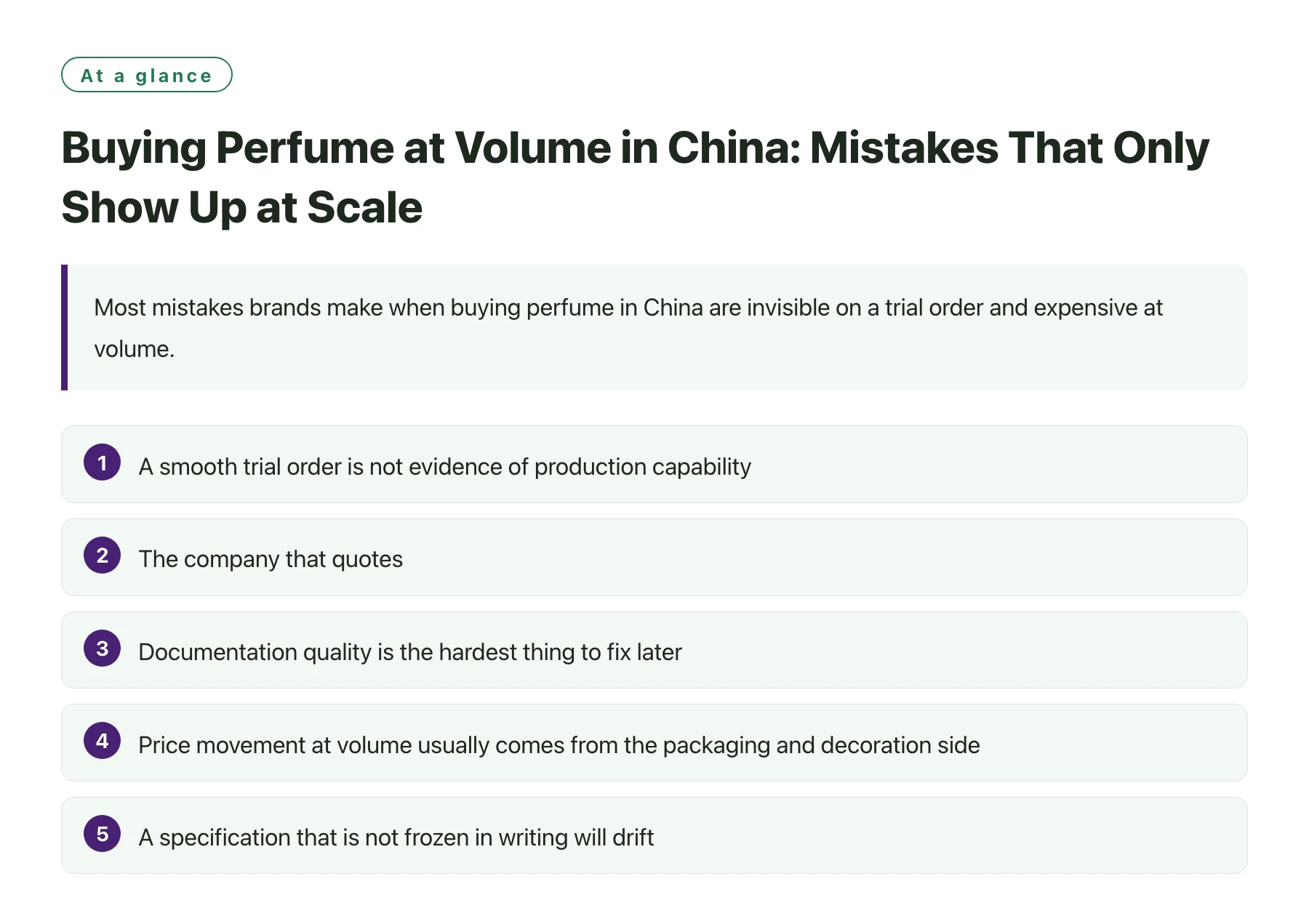
Key takeawaysA smooth trial order is not evidence of production capability; it is evidence that the supplier handled one small run with care. · The company that quotes, the company that compounds the fragrance and the company that fills the bottle are frequently three different legal entities, and the contract should name all of them. · Documentation quality is the hardest thing to fix later, so ask for sample documents in the first meeting rather than after the deposit. · Price movement at volume usually comes from the packaging and decoration side, not from the fragrance oil, which is why the bill of materials matters more than the headline quote. · A specification that is not frozen in writing will drift, and drift at volume means a rejected batch rather than a corrected sample. · Capacity should be evidenced with a schedule, not with a statement of monthly maximum output.
China is not a single sourcing market. It is dozens of overlapping ones, and the differences between them are matters of structure rather than of price. Some suppliers own compounding equipment and filling lines; some own one of those; some own neither and coordinate both. All three can look identical from a website and from a quotation.
The following six mistakes share a common feature: each one costs almost nothing on a small order and a great deal on a large one. They are written here from the point of view of a procurement team preparing a programme rather than a founder ordering samples.
Reading a supplier before you read the price
The first useful question is not what the supplier charges but what the supplier physically does. Compounding fragrance concentrate, filling finished product, and printing or decorating the container are separate activities, often performed by separate companies with separate quality systems. A supplier that outsources compounding is not necessarily a worse choice, but the brand is now relying on a supply chain it has never assessed.
The second question is who the brand's contract is actually with. If the quotation comes from one company, the compounding happens at a second, and the filling at a third, then the brand needs either a named subcontractor list in the agreement or a clear statement that the contracting party is responsible for its subcontractors. Ambiguity here is what turns a quality problem into a three-way argument.
Mistake one: treating a trial run as a capability test
A small order is handled by the most experienced people in the building, because it is visible and because a new customer is being won. A volume order runs on the standard line, with the standard crew, on a normal schedule. Those two things are not the same test.
The correction is to ask for evidence of repetition rather than evidence of ability. Which comparable programmes has this site run for at least three consecutive orders, and what did the batch records look like on the third one? A manufacturer that produces examples of fragrance projects will normally be able to talk about continuity, not just about a single successful launch.
Mistake two: accepting a quotation that is not a bill of materials
A per-unit price is a conclusion. The bill of materials is the reasoning, and it is what allows a buyer to see where the money goes and what changes when volume changes. Without it, a reorder negotiation is a conversation about a number rather than about inputs.
Ask for the fragrance compound, the container, the closure, the decoration, the carton, the leaflet and the assembly to be shown as separate lines with their own quantities and units. A supplier offering custom fragrance R&D and production should be able to produce that breakdown without difficulty, because it is the same structure the factory uses internally.
Six assumptions, the early signal, and the correction
| Assumption being made | Early signal it is wrong | What to do instead |
|---|---|---|
| The quoting company manufactures the product | Answers about the production process are less specific than answers about price | Ask for the site address, the names of subcontractors and the scope each party holds |
| Regulatory documents are a formality | The supplier offers a certificate list but no sample of an actual safety or composition file | Request a redacted sample file for a comparable product before discussing price |
| The fragrance oil is the main cost driver | The quote moves sharply when glass weight or decoration changes | Insist on a full bill of materials and track each line at reorder |
| The approved sample is the specification | Nobody can state the tolerance range around the reference sample | Write the specification and its tolerances into the agreement, then freeze it |
| Capacity means maximum output | The supplier quotes annual capability but not a month-by-month slot | Ask for a reservation schedule against the brand's forecast, with overflow named |
| A second supplier can be added later if needed | The supplier cannot describe what a handover would involve | Document the transfer steps for formula, tooling and records while the relationship is good |
The table is deliberately ordered by how often each assumption appears rather than by how much it costs. The first two are the ones buyers miss most, and both are answerable in a single meeting if the right questions are asked.
Three mistakes that are really about documents
Documents are the cheapest thing to get right at the start and the most expensive to reconstruct later. A brand that has not seen the shape of a safety file, a specification sheet or a batch record before it commits volume is buying a promise rather than a process.
It is also where the difference between an intermediary and a producer becomes obvious. An intermediary can forward documents it receives; a producer can explain them, point to the section that matters and say what would change if the formula changed.
Mistake three: leaving restricted materials to the factory
The brand is the party that will be held to account in most markets, so it should know which materials in its formula carry use restrictions. The applicable limits are published in the IFRA Standards, which are publicly available and organised by material and product category [1].
The practical use of that library is not to second-guess a perfumer. It is to know, at approval time, which materials have the least headroom, because those are the ones most likely to force a reformulation when a limit is revised or when the product moves into a new category.
Mistake four: assuming the factory's EU summary is the EU rule
Summaries are useful and incomplete. The European Commission publishes topic-level guidance on cosmetic products covering areas such as labelling, claims and ingredients, and that text, not a supplier's slide, is what the brand's own compliance adviser will work from [2].
This matters at volume because the cost of a late change is proportional to the order size. Artwork, cartons and labels are printed against a specification; a change after printing is a write-off, and a change after notification can delay a launch.
Mistake five: skipping independent testing because the factory tested it
Factory testing is part of production control, and it is not the same as the third-party testing a retailer may ask for. Independent laboratories run microbiology, stability, compatibility and heavy-metal testing programmes for cosmetics, and a brand selling into organised retail should know which of those it will be asked to produce and by when [3].
Choosing the laboratory early also removes a source of delay. If the retailer names an approved laboratory, book the slot when the first bulk batch is scheduled rather than when the container is already loaded.
Mistake six is the one that is hardest to see because it looks like good practice: assuming that a manufacturer able to produce a private label version of an existing concept is therefore able to develop a scent. Those are different capabilities with different teams. A buyer whose programme depends on original development should ask for private label perfume manufacturing to be described separately from development work, so the scope of each is clear before the brief is written.
The questions that separate the two kinds of supplier
A short list of questions does most of the work. Who owns the compounding equipment? Who writes the specification? Who signs the certificate of analysis? What happens to the batch record after the order ships, and for how long? If a batch fails the brand's own incoming check, who is notified and within what period?
The answers matter less than the specificity. A supplier with a real production system answers these in a minute, because these are the questions its own quality team asks. A supplier without one answers in generalities, and generally is not a basis for a volume commitment. A structured list of the questions to ask a perfume factory is worth carrying into every first meeting.
What a good answer sounds like
Good answers name people and files. They say which system holds the batch record, who signs the specification, which laboratory performs the stability work and how long samples are retained. They also volunteer the limits of what the site can do, which is a stronger signal of competence than an unqualified yes.
For a large programme, the manufacturer is often described as perfume manufacturer in China in a generic way, as though all such companies were interchangeable. They are not, and the six mistakes above are essentially six ways of discovering that too late.
Sources
- IFRA Standards Library (International Fragrance Association) —— The IFRA Standards Library lists the restrictions the fragrance industry applies to individual fragrance ingredients, based on safety assessments; it is the reference point for compliant fragrance formulation.
- European Commission: Cosmetic Products — Specific Topics —— EU pages covering specific cosmetics topics such as product claims, nanomaterials and animal-testing rules.
- SGS: Cosmetics, Personal Care & Household Testing —— Testing, inspection and certification services for cosmetics and personal care, including microbiological, stability and safety testing aligned with cosmetics GMP.
Frequently asked questions
How can I tell whether a Chinese perfume supplier is a factory or a trading company?
Ask process questions rather than credential questions. A producer can describe its compounding, filling and packing steps, name the equipment and explain what it does when a line is occupied. A trading company can usually describe the price and the schedule but not the process. A site visit confirms it, but the document trail normally reveals it first.
Is a larger order automatically cheaper per unit?
Not automatically. Volume usually reduces the share of setup and tooling cost per unit and improves the price of some purchased components, but it can also change the packaging options available, trigger minimum order quantities on a particular glass or pump, and increase the cost of any mistake. Ask for the bill of materials at both quantities and compare line by line.
What documents should I request before paying a deposit at volume?
A specification sheet with tolerances, a redacted safety and composition file for a comparable product, a sample certificate of analysis, a stability test report if one exists, the list of subcontractors and their scope, and a written statement of the production schedule against your forecast. If any of those cannot be produced for a comparable product, treat it as a warning.
Who is responsible if the bulk order does not match the approved sample?
That depends entirely on what the contract says, which is why the specification and its tolerances need to be attached to the agreement and frozen before production. With a written reference sample, agreed tolerances and a sampling plan, the question becomes a procedure. Without them it becomes a negotiation.
Do I need to visit the factory before committing to volume?
A visit is useful but it is not a substitute for documents, and it is not a quality audit unless someone who knows what to look for is doing the looking. Treat the visit as the confirmation step after the document review, not as the discovery step before it.