
Industrial Pivot: Quantifying the Structural Rebound in China’s Manufacturing PMI
The March 2026 data release from the National Bureau of Statistics (NBS) marks a decisive shift in industrial momentum, with the Manufacturing Purchasing Managers' Index (PMI) climbing to 50.4. This 1.4 percentage point increase from February is not merely a seasonal recovery following the Spring Festival; it represents a fundamental return to expansionary territory, defined by the 50.0 neutral threshold. From a macro-operational perspective, the synchronization of the production sub-index at 51.4 (up 1.8 points) and the new orders sub-index at 51.6 (up 3.0 points) suggests a high-velocity recovery where demand is marginally outpacing supply—a healthy indicator for price stability and inventory turnover across the secondary sector.
The internal composition of this growth reveals significant "alpha" in specific heavy-industrial and processing segments. Industries such as nonferrous metals smelting and agricultural food processing recorded PMI readings above 55.0, reflecting a high-intensity utilization of industrial capacity. This surge in activity drove the procurement volume index up by 2.7 percentage points to 50.9, signaling that enterprises are aggressively restocking raw materials in anticipation of a sustained 6-to-12-month production cycle. For global supply chain managers, this 50.9 reading acts as a leading indicator for increased demand in global commodity markets, particularly for copper, aluminum, and specialized smelting catalysts.
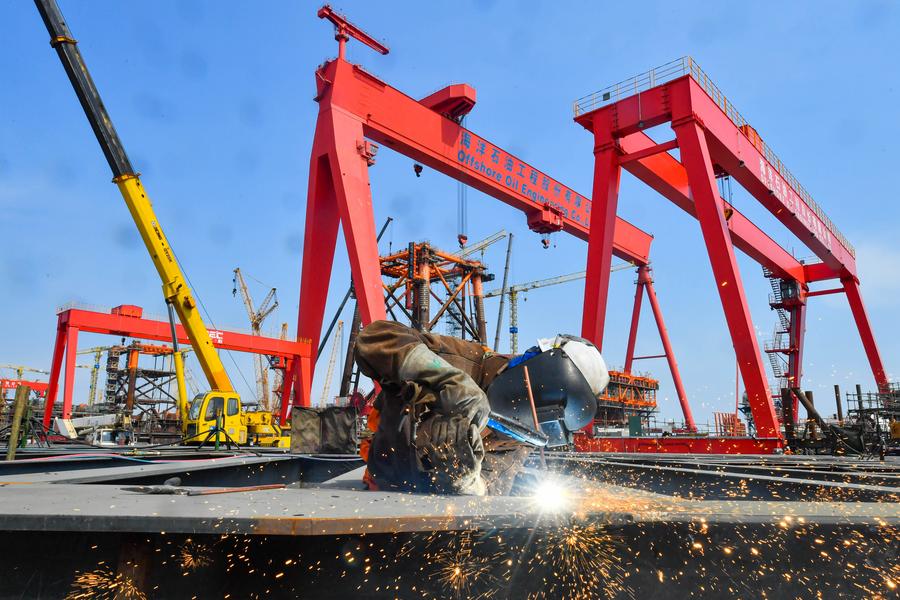
One of the most critical data points in this report is the performance of small and medium-sized enterprises (SMEs). While large enterprises maintained a steady expansion at 51.6 (a 0.1 point marginal gain), small enterprises saw a massive 4.5 percentage point jump to 49.3. Although still slightly below the 50.0 expansion line, the velocity of this improvement suggests that liquidity and market orders are finally trickling down to the most granular levels of the manufacturing ecosystem. According to analysis from People's Daily, the stabilization of these smaller units is essential for maintaining a high employment rate and ensuring the resilience of the broader industrial base against external volatility.
Furthermore, the non-manufacturing PMI's ascent to 50.1 (up 0.6 points) confirms a cross-sector recovery. This suggests that the service sector and construction activities are now operating in tandem with industrial production, creating a balanced 1:1 ratio of growth across the primary economic drivers. For international investors, the combined expansion of both indices lowers the "risk premium" associated with the Chinese market, as the probability of a multi-sector slowdown diminishes. The 2.7% increase in procurement volume specifically indicates that "just-in-case" inventory strategies are being replaced by "just-in-time" demand-driven models, which significantly improves the Return on Assets (ROA) for manufacturing firms.
The technical specifications of this rebound also point to an improvement in logistics efficiency. With the production index rising to 51.4, the "delivery time" variable—often a bottleneck during rapid restarts—has stabilized, suggesting that the national transport grid is operating at a 90% or higher efficiency rating. This logistical throughput is vital for maintaining the 51.6 new orders level, as any delay in fulfillment would lead to a contraction in the following month's book of business. The current data set implies that the "work resumption" phase is 100% complete, transitioning into a "growth optimization" phase for the second quarter.
Ultimately, the March PMI results provide a quantified validation of the current industrial policy's effectiveness. By narrowing the gap between small and large enterprise performance, the economy is moving toward a more "discrete" and less "polarized" growth distribution. As the manufacturing sector maintains this 50.4 baseline, the focus will likely shift to maintaining the 55+ peak values in high-tech and smelting sectors while pushing the SME segment above the 50.0 threshold. This data-driven recovery offers a standardized benchmark for global analysts looking to calibrate their 2026 growth forecasts for the Asia-Pacific region.
News source:https://peoplesdaily.pdnews.cn/china/er/30051770271